During my time serving as the President of the Solar Car Team, I quickly learned that project management is crucial to keep everything moving smoothly. As I increased my role of oversight to different teams and provided project support, I became increasingly interested in project management and wanted to expand my experience to become more proficient for both the Solar Car Team and my engineering career beyond college. I saw the Virginia Spaceport Authority (VSA) as the perfect opportunity. While it doesn't directly relate to my work with Solar Car, it perfectly mirrors the high-stakes, real-world engineering environments I will navigate after graduation. I was tasked with supporting multi-year capital renovations on Pad-0A. This multi-user launchpad required complex upgrades to support the Northrop Grumman Antares 330 program, the Firefly Aerospace Alpha program, and Eclipse, a collaborative rocket program between the two companies. My core objective was to immerse myself in these developments and ultimately know I helped make these launches happen.
To achieve that objective, my day-to-day reality often revolved around the essential minutiae of project management. I quickly realized that a significant portion of my role was simply following up, anticipating bottlenecks, and asking countless questions to keep projects on track to completion. Whether I was calling contractors to track down delayed materials, emailing about bill of ladings and bridge permits so delivery drivers could access Wallops Island, or formally submitting and reviewing project submittals, these small, regular tasks were essential to our progress. I was constantly attending weekly construction coordination tag-ups, coordinating electrical and water outages for equipment upgrades, and conducting site walkdowns to take progress photos. It was through all of this work that I learned that our job was not just to manage the project, but to know absolutely everything about it so it could go off without a hitch.
Throughout my time at VSA, I learned how to take ownership of my work and act as the bridge between the Mid-Atlantic Regional Spaceport (MARS), NASA, contractors, and customers. This became especially evident while I managed the schedule for the RP-1 Fire Suppression System. I was responsible for anticipating the contractor's needs ahead of time to ensure they were prepared for the start of their work. This meant asking the right questions early on, checking safety plans and timelines, and maintaining constant communication with the technical operations team to coordinate end-of-installation testing. I traveled to the launchpad often to check on the contractor and their work if it matches with the designs they have submitted. By the time my internship concluded, the project was at its halfway point.
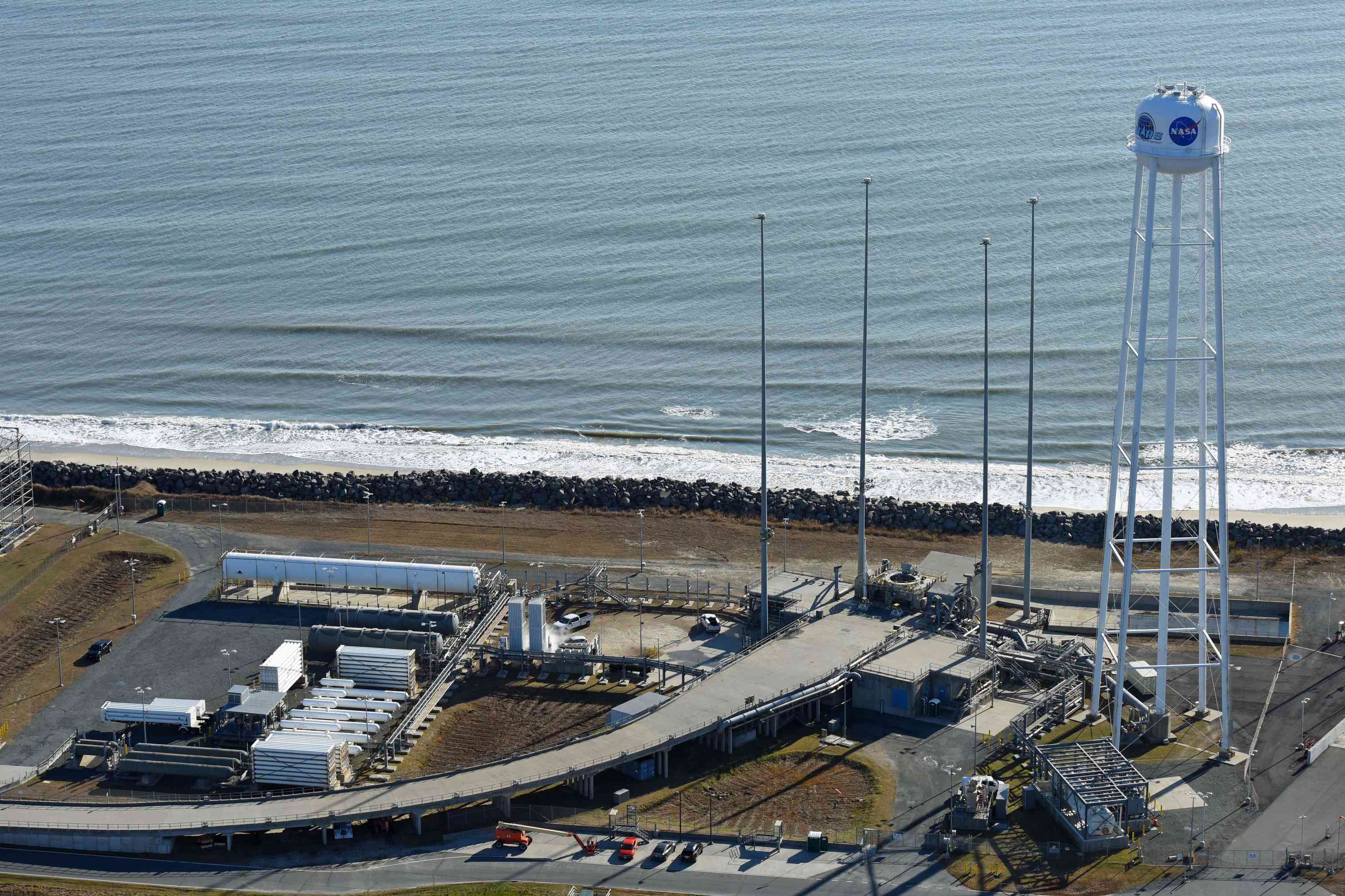
Throughout my time at VSA, I learned how to take ownership of my work and act as the bridge between the Mid-Atlantic Regional Spaceport (MARS), NASA, contractors, and customers. This became especially evident while I managed the schedule for the RP-1 Fire Suppression System. I was responsible for anticipating the contractor's needs ahead of time to ensure they were prepared for the start of their work. This meant asking the right questions early on, checking safety plans and timelines, and maintaining constant communication with the technical operations team to coordinate end-of-installation testing. I traveled to the launchpad often to check on the contractor and their work if it matches with the designs they have submitted. By the time my internship concluded, the project was at its halfway point.
One of the most defining lessons I learned during this daily routine was that things rarely go right the first time. Initial plans frequently slip or require modification due to unexpected interferences or design discrepancies. During the installation of the Pad-0A Lightning Protection System (LPS), I saw firsthand how crucial it is to verify that concrete drilling would not interfere with existing rebar underneath the pad. Catching and addressing these challenges is vital, as any mistake could cost significant time and money to correct. My mentors and I had countless meetings throughout with the contractor to make sure every marking is accurate and everyone is on the same page. When these inevitable interferences occur and plans must change, formal Requests for Information (RFIs) are essential to officially pivot and agree on new solutions. I was tasked with sorting and logging all the RFIs across the entire Pad-0A renovation project. Seeing just how many were submitted (where sometimes more than twenty from a single contractor over the span of a project) truly highlights their significance. It showed me how heavily project managers rely on proper documentation to keep work moving when site realities simply do not match the technical drawings.
My time at VSA gave me many opportunities to work closely with other departments than the project management team. The MARS 32 refit project was a collaborative effort with a technical operations intern whose team discovered issues with how commodity tanks were being filled inefficiently, different than what the manufacturer recommended. While he focused on the technical aspects and deliverables, I handled the backend logistics. I worked alongside senior managers to draft the formal project proposal, write up the technical objectives, and navigate the required permissions to turn a discovered inefficiency into an approved, funded project.
We always strive for better, driven by the spaceport's standard of excellence. For my final capstone, I took ownership of identifying workflow bottlenecks from my daily experiences and developing automated solutions to streamline operations and save time. I tested and implemented systems using Microsoft Power Automate and Microsoft Lists to centralize contractor documentation, standardize file naming schemes, and improve the logging process for RFIs and weekly site photos. None of this growth, or my ability to tackle these challenges, would have been possible without the incredible network of project management mentors who guided me along the way. They provided an open platform where I never hesitated to bounce ideas around or ask questions. By allowing me to shadow them in countless high-level meetings and trusting me with ownership of my work, they gave me the room to learn at a fast pace. As one of my colleagues said, "at the end of the day, we all want to see the rocket launch". Navigating new developments, drafting Requests for Proposals (RFPs), and conducting daily site walkdowns alongside these mentors instilled a deep appreciation for the unseen work that makes these achievements in aerospace possible. I walked away from this internship with a refined engineering focus and a proven ability to drive complex, multi-stakeholder projects from the ground up.